 |
 |
|||
| People around the world associate Del Mar with names like Bing Crosby, Jimmy Durante, and Seabiscuit vs. Ligorati, but for those who call Del Mar home — whether it’s a first or second one — the quaint seaside town offers so much more beyond history-making at the track. In addition to being nestled against the Pacific, Del Mar is rich in culture and restaurants and filled with citizens that display an active sense of civic duty and pride. Del Mar, therefore, draws those with a thirst for new ideas and experiences that is balanced against a taste for life’s finer things. |
First settled in the
late 1800s, it wasn’t until San Diego Gas & Electric first extended
service to the area in the 1920s that residential neighborhoods began
to sprout in earnest. Today, the city — Del Mar incorporated as
a city in lieu of joining San Diego proper in 1959 — is pretty much
all grown up, there is literally no where to physically evolve anymore
within boundaries defined by I-5 to the east and the Pacific Ocean to
the west. And Del Mar’s city council has been notoriously staunch
in preserving the character of this quaint community by strictly enforcing
growth restrictions to avoid over development that has occurred in other
parts of San Diego.
Though there are general descriptions that apply to the community as a whole — charming, Old World feel, strong artistic tendencies — the sum is composed of very distinctive parts. An area that is in general sought after, there are neighborhoods more in demand than others, and therefore more costly. But in general, expect to pay at least $1.5 million for “entry-level” Del Mar housing — meaning you’ll get a house you can live in, but that, considering many homes and condominiums were built in the 1970s and earlier, you’ll want to almost completely re-do.
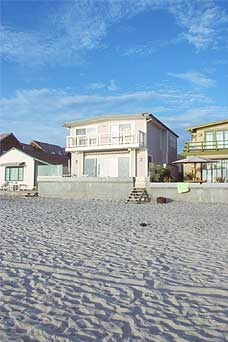
Those
seeking a beachside getaway are drawn to the Beach Colony area of Del
Mar, an approximate 90-home-long strip of cottages that stretch on the
beach side against infinitesimal grains of white Pacific sand. Shawn Hethcock,
real estate agent with the Willis Allen Company, describes this community
as “very much its own animal,” and explains that these are
the highest priced homes in Del Mar. High price tag notwithstanding, she
estimates that about 90 percent of these beachside properties are second
homes. Some well-known residents fortunate enough to call the colony (second,
or more) home?
John Moores, Jenny Craig, Trevor Hoffman, and Ernie Moody. Hethcock stresses
that buildable lots on the sand — the average size lot is 4,000
square feet — are extremely rare, but if one were to become available
today it would list for about $6.5 million — and that’s land
value only. A ramshackle home that needs everything remodeled or updated
on an equally small lot would fetch around $8.5 million. But most homes
here — when they become available — sell in the low double
digit millions.
The Bluff area, also west of Camino Del Mar and with access to the beach but higher up, is conversely made up of predominately full time residents. Lots are zoned R2, so even those that might have started out a healthy size, around 9,000 square feet, have long since been split. Houses and lots therefore both tend to be on the smaller side — most of today’s homes are converted beach bungalows — and the area attracts those who enjoy the beach lifestyle year-round. There are some families, but since lots are small, it’s primarily couples who are lured by an ability to walk to the restaurants and shopping of the village as well as the ocean. In May 2004, a home right on the bluff with unobstructed views — these homes are few and far between — sold for $7 million. Streets run perpendicular to the bluff, and the farther back from the ocean, the more affordable homes tend to be. Back from the edge, prices are ranging from $1.5 to $3 million.
Continuing east of Camino Del Mar uphill to crest canyon (locals call the area “up on the hill”), scenery becomes more wooded, the streets windy, and beach-sized lots give way to more typical residential sizes. According to Hethcock, this area up on the hill attracts buyers who want more square footage but don’t want brand new. Since all new construction needs to be approved by the city’s Design Review Board — a process that can take as long as two years — there tends to be a lot of remodeling versus tearing down and starting from scratch. According to Hethcock, the result is that “everything in Del Mar has character, because people work with what they have.”
Above Flower Hill Mall rests rural Del Mar. A country feel, most lots average about an acre in size. It’s county run, not city and in general, you get “close to a Rancho Santa Fe rural feel for substantially less money,” says Hethcock.
Del
Mar’s schools, from elementary on up, rank among the highest in
the state, so families make up a large percentage of buyers in the Torrey
Pines and “rest of Del Mar” area that is composed of anything
else west of I-5. Lots tend to be larger in these areas so homes are larger
(building restrictions limit structure square footage to a percentage
of lot square footage) and the streets wider, not so windy as in hillier
sections; entry level prices into these neighborhoods average $1.2-1.5
million.
Though multiple millions no longer get what they used to in a market where one-point-somethings are considered entry level in a community in which there has been no significant new construction since the 1970s, Hethcock still considers North County coastal in general, and Del Mar in particular, to be “the best real estate investment in San Diego.” Citing climate, proximity to the ocean, and convenience to culture and restaurants, she firmly believes Del Mar is “an area that has been and will continue to be one of the best buys in San Diego.” As far as any impact future blips in the economy might have? She explains that we might see temporary flattening in prices, but it’s not typical to see large losses in value in any area west of I-5. “It’s not magic,” she says, “it’s simply the laws of supply and demand.”
Located in this most desirable sector of Del Mar, where most of these ocean front homes are vacation properties not primary residences, this 3,209-square-foot duplex sits on a 3,920-square-foot lot that is mere steps from the sand. Previous owners utilized the seven-bedroom beach cottage with caretaker’s quarters and parking for nine cars as a family retreat. Built in 1951, the property last changed ownership in 1989 and was sold for $1.8 million. With only about $800,000 in improvements recorded over the years, the property closed escrow in July 2004 for $8.5 million.
© 2004 Rocket Publishing Company, Inc. 760.942.2330 P.O. Box 676130, Rancho Santa Fe, CA 92067
